> For the complete documentation index, see [llms.txt](https://docs.limio.com/llms.txt). Markdown versions of documentation pages are available by appending `.md` to page URLs; this page is available as [Markdown](https://docs.limio.com/product/journey/what-are-limio-journeys/create-a-journey-based-on-subscription-offer-labels.md).
# Journey Based on Subscription Offer Labels
## **Overview**
Configuring a journey based on **subscription offer labels** allows you to personalize user experiences by directing customers to different pages depending on their current subscription status. For example, you might want to:
* Route **existing subscribers** to an **upgrade or renewal page**.
* Direct **non-subscribers** to a **special promotional offer**.
Limio allows you to segment users dynamically by checking their associated subscription offer labels. This guide explains how to create a journey and apply **subscription-based criteria** to control user flow.
*Example: If a user is subscribed to an offer labelled **"Premium Subscription"**, they can be routed to a **special upgrade page**. Users without this label can be directed to a **promotional subscription page**.*
## **Before you start**
Ensure that the required Offer Label(s) have been created in the Limio app and applied to the relevant Offers.
Check this by navigating to Offers in the left-hand navigation, selecting your Offer > locating the section Categorisation > then checking the Labels here.
## **Creating a Journey**
1. Select **Journeys** from the left-hand navigation panel.
2. Click **New journey**.
3. Enter a name for the journey and click **Save**.
4. Click **Set starting point** to define how users enter the journey:
* Choose an existing tag or create a new one.
* (Recommended) Click **Set fallback tag** to ensure proper routing.
5. Select the shop **Domains** whose tags you want to search.
## **Adding Subscription Offer Label criteria**
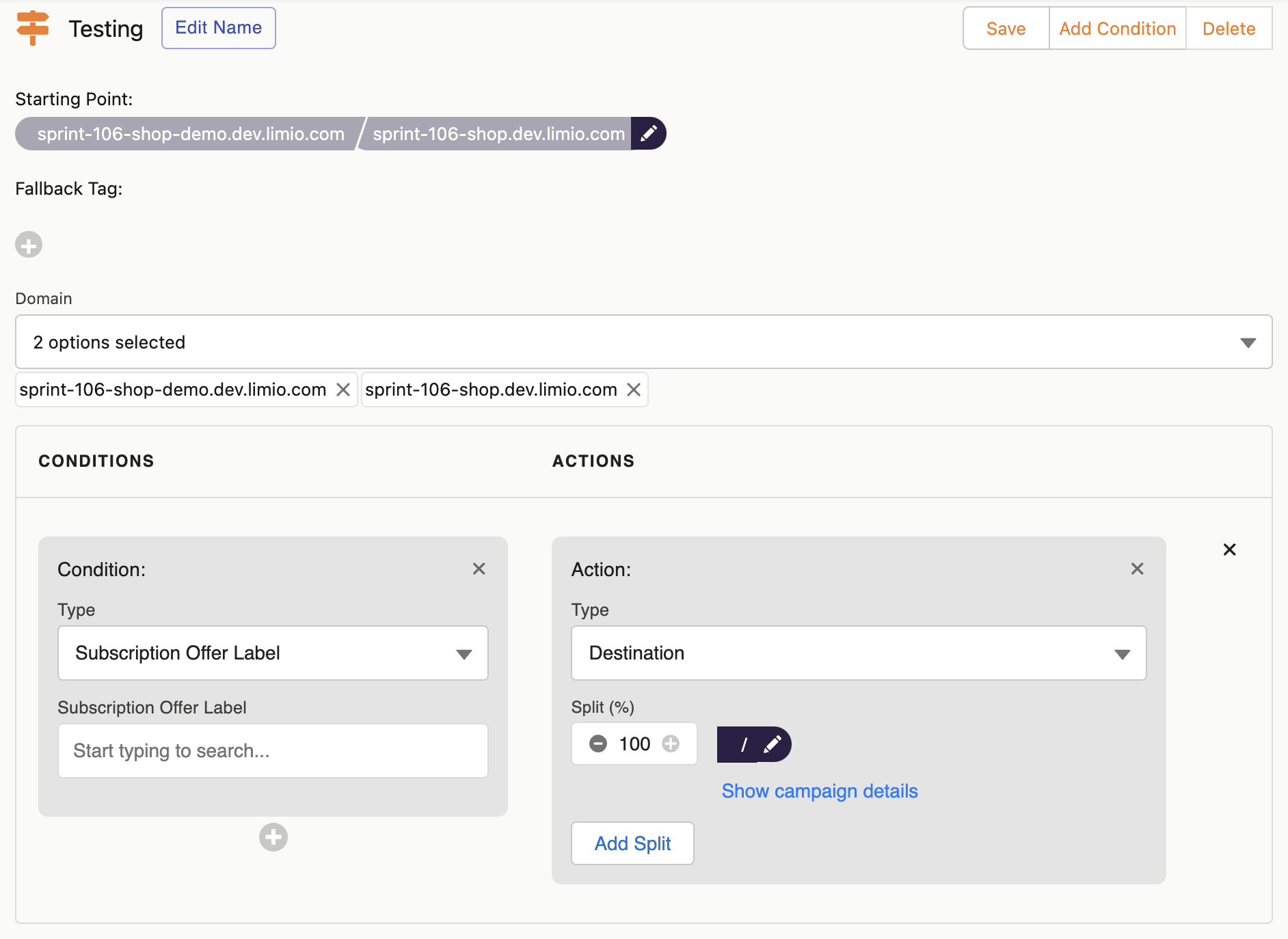
1. In the rule, click **Add condition**, then open the **Type** dropdown and select **Subscription Offer Label**.
2. In the **Subscription Offer Label** field, enter the specific label(s) associated with the subscription offers you want to target.
3. Under **Action**, ensure **Type** is set to **Destination**.
4. Click **Add action** if the rule has none, then **Add Split**. The split defaults to **100%**. Click the pencil ✏️ on the tag next to it and choose the endpoint.
* Click **Add rule** to add another rule to the journey.
* Click **Add condition** in a rule to add an **AND** criteria to that rule.
5. Finally, click **Save** to put the Journey live.
**Verification Steps**:
1. Impersonate a user with a subscription with the specified Offer Label attached(e.g Premium Subscription).
2. Access the starting point URL.
3. Verify that the user is redirected to the correct destination.
📷 *Screenshot: View of the "Subscription Offer Labels" condition in the Journeys tab.*
---
# Agent Instructions
This documentation is published with GitBook. GitBook is the documentation platform designed so that both humans and AI agents can read, navigate, and reason over technical content effectively. Learn more at gitbook.com.
## Querying This Documentation
If you need additional information that is not directly available in this page, you can query the documentation by asking a question.
Perform an HTTP GET request on the following URL with the `ask` and `goal` query parameters:
```
GET https://docs.limio.com/product/journey/what-are-limio-journeys/create-a-journey-based-on-subscription-offer-labels.md?ask=&goal=
```
`ask` is the immediate question: it should be specific, self-contained, and written in natural language.
`goal` is what the user is ultimately trying to achieve, the reason they need the answer. Sharing it helps GitBook give you a better, more relevant answer. A goal is most helpful when it describes the outcome the user wants rather than restating the question. For example, with `ask=how do I create an API token`, a goal like `automate deployments from our CI pipeline` lets GitBook tailor the answer to that use case.
The response will contain a direct answer to the question and relevant excerpts and sources from the documentation.
Use this mechanism when the answer is not explicitly present in the current page, you need clarification or additional context, or you want to retrieve related documentation sections.