> For the complete documentation index, see [llms.txt](https://docs.limio.com/llms.txt). Markdown versions of documentation pages are available by appending `.md` to page URLs; this page is available as [Markdown](https://docs.limio.com/product/introduction/readme.md).
# Welcome to Limio
Limio enables Go-To-Market teams to accelerate revenue by optimising every sales channel. We're excited to have you using Limio to develop new commerce experiences across your channels.
### Platform Overview
**Limio Commerce Platform** is the turnkey solution for subscription businesses needing to unify product-led growth (PLG) and sales-assisted motions across all channels. Built specifically for subscription models, it delivers fast, responsive, mobile-friendly commerce experiences that convert users from free trials to paid subscriptions and drive expansion revenue.
**One Platform, Every Channel:** Limio combines Content Management, Digital Asset Management, Product Catalog Management, Order Management, and eCommerce into a single application that powers your entire customer journey - from initial product discovery to renewals and upsells.
**Unified PLG & Sales-Led Growth:**
* **Product-Led Growth**: Self-service onboarding, in-app upgrade flows, usage-based billing triggers, and frictionless free-to-paid conversions
* **Sales-Assisted Growth**: Quote-to-cash workflows, agent-initiated orders, and seamless handoffs between self-service and sales teams in Salesforce
* **Partner Portal:** Self-service ordering and customer management for partners
**Native Integration Advantage:** With out-of-the-box integration to billing systems like Zuora and CRM like Salesforce, subscription businesses can launch complete commerce experiences rapidly, no custom development, no middleware, no integration headaches.
**The platform includes the following key components:**
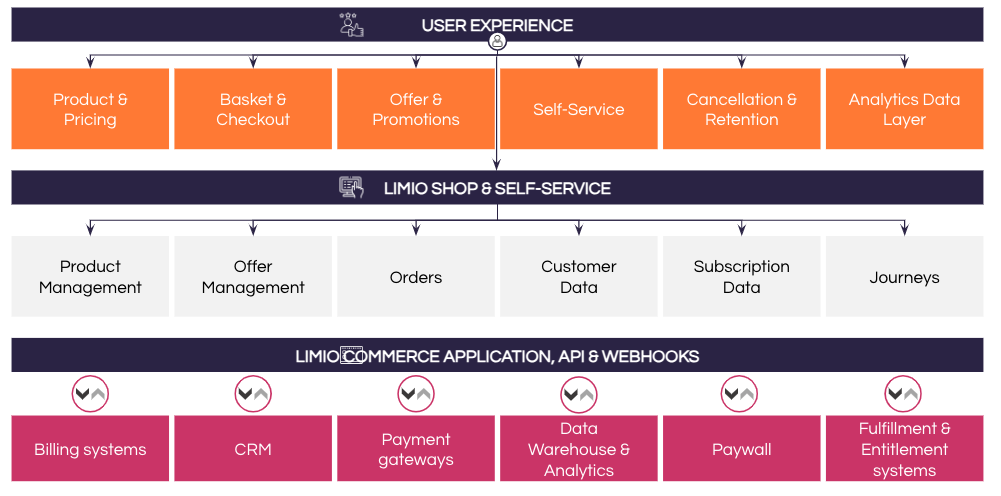
* **Limio Catalog:** Product Information Management and Digital Asset Management designed for rapid ecommerce and PLG experimentation. Marketers can manage product offerings, create compelling trial experiences, and package conversion journeys through a WYSIWYG editor ('Limio Page Builder'). Build everything from freemium landing pages to upgrade prompts without developer involvement.
* **Limio Shop:** A subscription eCommerce platform optimised for product-led acquisition. Provides modern, configurable, hosted experiences including pricing pages, frictionless checkout, shopping baskets, and conversion-optimised order completion flows. Supports free trials, usage-based pricing, and seamless free-to-paid conversions - all customisable through Limio Catalog.
* **Limio Self-Service:** Comprehensive subscriber or partner portal that drives product adoption and reduces churn. Includes secure authentication, account management, subscription controls, upgrade/downgrade flows, and intelligent cancellation prevention. Enables customers to self-serve throughout their entire lifecycle while providing expansion opportunities.
* **Limio Subscriptions:** Unified subscription management that tracks customer journeys across all channels. Monitor customers, orders, subscriptions, and behavioral events from initial product trial through renewal. Provides the data foundation for PLG analytics and automated lifecycle campaigns.
* **Limio for Salesforce:** Native Salesforce integration enabling omnichannel PLG and sales-assisted workflows. Sales teams can create subscriptions, apply promotions, and seamlessly hand off to self-service - all within Salesforce CRM.
The Limio Commerce Platform works hands-in-hands with Limio for Salesforce to power omnichannel commerce. See more at [What is Limio for Salesforce](https://docs.limio.com/salesforce/managed-package-overview).
---
# Agent Instructions
This documentation is published with GitBook. GitBook is the documentation platform designed so that both humans and AI agents can read, navigate, and reason over technical content effectively. Learn more at gitbook.com.
## Querying This Documentation
If you need additional information that is not directly available in this page, you can query the documentation by asking a question.
Perform an HTTP GET request on the following URL with the `ask` and `goal` query parameters:
```
GET https://docs.limio.com/product/introduction/readme.md?ask=&goal=
```
`ask` is the immediate question: it should be specific, self-contained, and written in natural language.
`goal` is what the user is ultimately trying to achieve, the reason they need the answer. Sharing it helps GitBook give you a better, more relevant answer. A goal is most helpful when it describes the outcome the user wants rather than restating the question. For example, with `ask=how do I create an API token`, a goal like `automate deployments from our CI pipeline` lets GitBook tailor the answer to that use case.
The response will contain a direct answer to the question and relevant excerpts and sources from the documentation.
Use this mechanism when the answer is not explicitly present in the current page, you need clarification or additional context, or you want to retrieve related documentation sections.
%20(1).png?alt=media)