> For the complete documentation index, see [llms.txt](https://docs.limio.com/llms.txt). Markdown versions of documentation pages are available by appending `.md` to page URLs; this page is available as [Markdown](https://docs.limio.com/labs/labs-components/loss-aversion-component.md).
# Loss Aversion Component
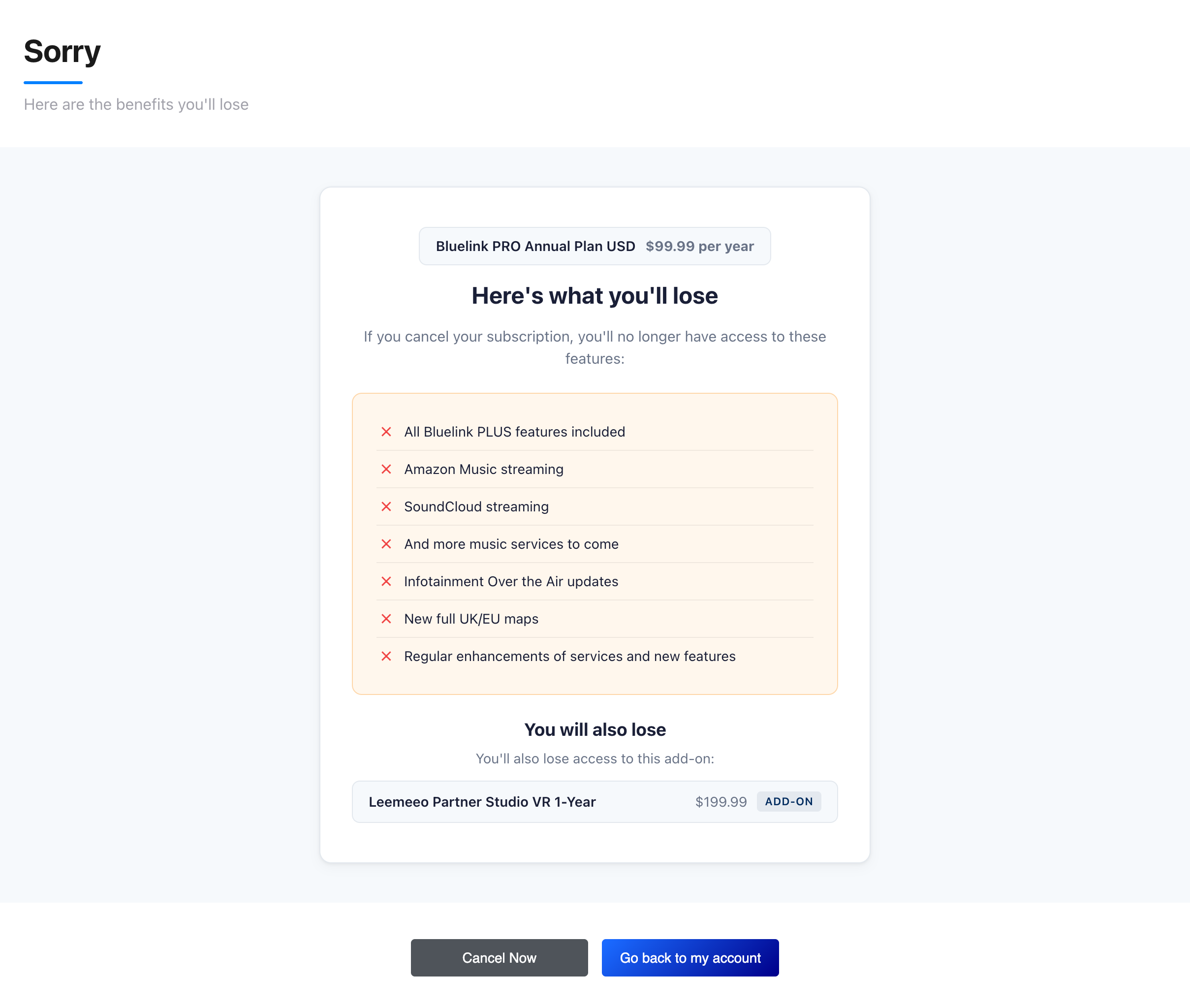
A cancel-flow component that pulls the subscriber's specific plan features (`offer_features`) and renders them as a visual checklist — showing exactly what they'd lose by cancelling. Works with add-ons too, so subscribers see the full picture: base plan features plus any extras they've purchased.
Most cancel flows ask "are you sure?" — this one shows the concrete value at stake. The component is fully configurable per-brand and can be styled to match your existing cancel experience ([Broken mention](broken://spaces/xxxhzz4ER0TH1oIFAttf/pages/muYCmiXOpzUbZ5ng5f6W)).
## How it works
When a subscriber hits the cancellation page, the component reads their active offer and any attached add-ons, then renders a personalised list of everything included in their subscription. Each cancel reason can optionally trigger a save path — for example, "too expensive" could redirect to a downgrade offer, or "missing features" could surface an upsell.
## Why it matters
Behavioural economics applied to retention. Showing specific, personalised value is far more effective than a generic confirmation step. The component has been tested in live demos and is designed to integrate directly into existing self-service cancel flows without changes to the underlying subscription logic.
***
{% hint style="info" %}
**This is a Labs feature.** We're experimenting with this and it's not yet part of the core platform. Interested in early access or want to help shape it?
[Request access →](mailto:hello@limio.com?subject=Labs%20—%20Loss%20Aversion%20Component)
{% endhint %}
---
# Agent Instructions
This documentation is published with GitBook. GitBook is the documentation platform designed so that both humans and AI agents can read, navigate, and reason over technical content effectively. Learn more at gitbook.com.
## Querying This Documentation
If you need additional information that is not directly available in this page, you can query the documentation by asking a question.
Perform an HTTP GET request on the following URL with the `ask` and `goal` query parameters:
```
GET https://docs.limio.com/labs/labs-components/loss-aversion-component.md?ask=&goal=
```
`ask` is the immediate question: it should be specific, self-contained, and written in natural language.
`goal` is what the user is ultimately trying to achieve, the reason they need the answer. Sharing it helps GitBook give you a better, more relevant answer. A goal is most helpful when it describes the outcome the user wants rather than restating the question. For example, with `ask=how do I create an API token`, a goal like `automate deployments from our CI pipeline` lets GitBook tailor the answer to that use case.
The response will contain a direct answer to the question and relevant excerpts and sources from the documentation.
Use this mechanism when the answer is not explicitly present in the current page, you need clarification or additional context, or you want to retrieve related documentation sections.